
- 424/2/9/1b.
- Ffeil
- 1914, Dec. /
First line: The summer nests uncovered by autumn wind. Written in Steep. Typescript. Version B.
Thomas, Edward, 1878-1917


First line: The summer nests uncovered by autumn wind. Written in Steep. Typescript. Version B.
Thomas, Edward, 1878-1917
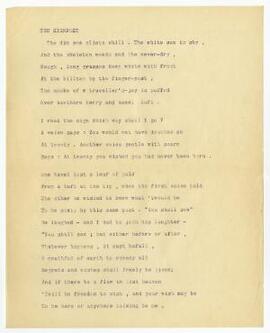
First line: The dim sea glints chill. The white sun is shy. Written in Steep. Typescript.
Thomas, Edward, 1878-1917

Correspondence and printed material relating to Dr David Thomas,
Correspondence and printed material relating to Dr David Thomas' trials as a conscientious objector and his efforts on behalf of others.
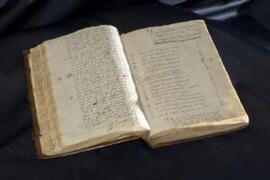
Salusbury family, Llewenni: poetry, &c.,
Poetry, masques, short plays, memoranda, etc. by 17th century members of the Salusbury family of Llewenni, Denbighshire, in particular Sir John Salusbury (1567-1612), Sir Henry Salusbury (1589-1632), first baronet, and Sir Thomas Salusbury (1612-1643), second baronet, whose poem 'History of Joseph' was published in 1636.
Salusbury family, of Lleweni and Bachygraig

Care of Welsh soldiers in London hospitals,
Minute book, 1915-1920, of the Committee for the Care of Wounded Welsh Soldiers in London Hospitals, organised by the London Welsh Churches.
The majority of the minutes are signed by the Committee's President, the Rev. H. Elvet Lewis. Items found loose within the volume have been either tipped in (ff. 15-16, 24, 28-29, 48) or inserted in an archival envelope (ff. 76-84).
Committee for the Care of Wounded Welsh Soldiers in London Hospitals.

Care of Welsh soldiers in London hospitals,
A ring binder containing records, 1916-1917, of visits to hospital patients on behalf of the Committee for the Care of Wounded Welsh Soldiers in London Hospitals, listed by names of participating churches.
Committee for the Care of Wounded Welsh Soldiers in London Hospitals.
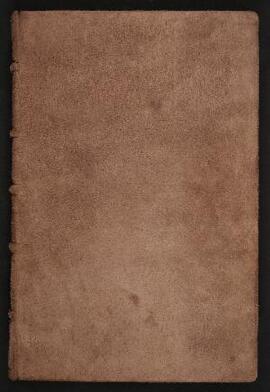
A late-seventeenth century volume, compiled 1683/4-1686, 1693/4, at the office of the Master of Rolls in Philadelphia, recording sales to Welsh Quakers of lands in the area called the Welsh Tract, in Pennsylvania, along with some other transactions. The original indentures were dated between September 1681 and March 1685/6.
The indentures were recorded, in at least three clerical hands, between February 1683/4 and August 1686, with some sections in non-chronological order (pp. 1-57, 185-196). Of the eighty-one transactions recorded, some fifty-six indentures detail sales by six of the Welsh Original Purchasers (who bought land directly from William Penn) to fifty-six Under Purchasers in six Welsh counties (pp. 29-159, 166-261, 264-276, 288-310), the majority being lands sold by John ap Thomas of Llaithgwm and Edward Jones of Bala, both in Merioneth (pp. 166-196, 212-239) and Richard Davies of Welshpool, Montgomeryshire (pp. 59-159, 165, 239-261, 264-270, 294-301, 305-311). Rowland Ellis, Brynmawr, is the grantee of a deed of 30-31 July 1682 (pp. 294-301). Three other miscellaneous documents are also transcribed (pp. 165-166, 261-262, 367), including a previously omitted assignment added to the end of the volume in January 1693/4 (p. 367). The remaining twenty-two transactions involve non-Welsh purchasers from Wiltshire, Herefordshire and elsewhere in England and a few in Pennsylvania (pp. 5-18, 159-164, 262-264, 276-288, 311-367). A single record refers to an original sale of 250 acres by William Penn in September 1681 (pp. 333-337). The majority of the transactions were deeds of lease and release with receipt, although the lease portion (occasionally) and the receipt (often) may be absent. There are miscellaneous underlinings and marginal annotations in pencil, [?1921] (see arithmetical calculation on p. 159), throughout the volume. The Rolls Office in Philadelphia was established in January 1683/4, with title holders then required to have their deeds registered there; the Master of Rolls during this period was Thomas Lloyd, formerly of Dolobran, Montgomeryshire.
Philadelphia County (Pa.). Master of Rolls

A manuscript of the second half of the thirteenth century containing 'Y Gododdin', a series of awdlau lamenting warriors slain in battle at Catraeth, and believed to have been originally composed by Aneirin at the end of the sixth century (pp. 1-24). The awdlau are followed by four poems known as the gorchanau: Gorchan Tudfwlch (pp. 25-26), Gorchan Adebon (p. 26), Gorchan Cynfelyn (pp. 26-28) and Gorchan Maeldderw (pp. 28-38).
The manuscript was written by two scribes: scribe A (pp. 1.1-23.5, 25.1-30.11) and scribe B (pp. 23.6-24.21, 30.12-38.22). The hand of scribe B is also responsible for Peniarth MS 14, pp. 1-44 and Peniarth MS 17; see Ingo Mittendorf, 'Sprachliche und orthographische Besonderheiten eines mittelkymrischen Textes aus dem 13. Jahrhundert (Gwyrthyeu e Wynvydedic Veir)', in Akten des Zweiten Deutschen Keltologen-Symposiums, ed. S. Zimmer, R. Ködderitzsch and A. Wigger, Buchreihe der Zeitschrift für celtische Philologie, 17 (Tübingen, 1999), p. 129. Daniel Huws suggests the Cistercian abbey of Aberconwy as a likely location of the scriptorium; see Medieval Welsh Manuscripts (Cardiff and Aberystwyth, 2000), 75.
Aneirin
Edward Thomas letters to O. M. Edwards
Twelve letters, 1900-1902, from Edward Thomas to Sir Owen M. Edwards, his erstwhile tutor at Lincoln College, Oxford, written shortly after Thomas had left university, their main purpose being to ask for guidance in seeking employment; they also reflect his attachment to Wales and his interest in the Welsh language.
Thomas, Edward, 1878-1917

Lewis Morris' De Historia Piscium
The second edition (or reissue), [1740], of Francis Willughby's De Historia Piscium Libri Quatuor (Oxford, 1686) [ESTC N51867, where it is dated c. 1743]. The work is made up of the De Historia Piscium Libri Quatuor (ff. 2-177), together with 'Appendix ad historiam naturalem piscium' (London, 1740) (ff. 178-205) and a sequence of some 187 engraved plates from the first edition (on the rectos of ff. 206-392). The plates have been extensively annotated (with English and Welsh names, and eyewitness accounts), and sometimes further illustrated (on ff. 215, 224, 244, 248, 281 verso, 283, 295, 341 verso, 347), by Welsh polymath Lewis Morris.
Morris' marginal notes glossing the printed text appear on ff. 4 recto-verso, 85, 88 verso-90, 92, 97-104 verso, 115 verso-116, 118, 137, 146, 165 recto-verso, 175 verso-176, 178, 188 verso-189, 191, 192, 194 verso-195 verso, 197, 198 verso-199, 200, 202-204; his Welsh translations of fish names on ff. 16 verso-18; and extensive notes on fish on ff. 206-391 passim. These last set of notes reflect Morris' retrospective interest in fish seen on the coast of Anglesey (ff. 189, 213, 215, 227, 240, 242, 250, 251 verso, 280 verso, 281 verso, 283, 284, 285, 286, 341 verso, 347) and elsewhere (ff. 224, 248, 295 verso) before his departure to Cardiganshire in 1742. Further accounts of fish seen in Cardigan Bay are on ff. 241, 243 verso, 295 (dated 1747) and 311 (dated 1745). It is possible that these notes form the basis of Lewis Morris' projected, but unpublished, Natural History of Anglesey (see Dafydd Wyn Wiliam, Lewis Morris: Deugain Mlynedd Cyntaf ei Oes 1700/1-42 ([Bodedern], 1997), p. 150). See also Maredudd ap Huw, 'Pysgod Lewis Morris', Tlysau'r Hen Oesoedd, 37 (Ebrill 2015), 3-10.
Morris, Lewis, 1701-1765.
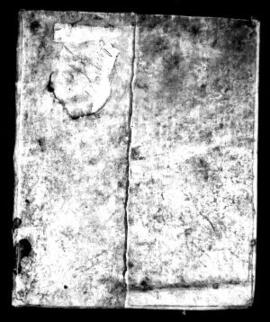
A volume containing a copy, 1669, in the hand of Thomas Rowlands, clerk, of 'History of the Gwydir Family' by Sir John Wynn (1553-1627), Gwydir, Caernarvonshire (ff. 2-84 verso). It is the earliest known dated copy of a recension of the work represented by thirteen other copies (see below). It is probably the manuscript belonging in 1674 to Morris Parry, rector of Llaneilian-yn-Rhos, Denbighshire, from which the copy in NLW MS 3075D was made, and the manuscript described by Angharad Llwyd as 'a quarto volume of Syr John Wynn's History of Gwydyr, Ancient, and in good preservation' which in 1828 was in the possession of Richard Lloyd Williams of Hafodwryd, Penmachno, Caernarvonshire, then residing at Llwyn, Llanrhaeadr-ym-Mochnant, Denbighshire (see Transactions of the Cymmrodorion or Metropolitan Cambrian Institution, 2 (London, 1828), 44). Bound together are pedigrees and memoranda in several early-eighteenth century hands, including notes copied 'out of Penbedw MS' (NLW MS 3075D, p. 90), being transcripts of marginalia from 'Dr Humphreys's Copy' (Brogyntyn I.13, ff. 62 verso-3, 76) (ff. 85-6); a note on Meredith Wynn ap Evan ap Robert and his descendants (see also NLW MSS 27B, pp. 111-114, 16969B, pp. 128-132 and 21253D, ff. 27 verso-28 verso, where 'H. Bangor 1700' is given as the source) (ff. 89-91); pedigrees of the Wynn family of Gwydir and its collateral branches (ff. 86 verso-91, 95-98 verso); and 'Arfau pump brenhinllwyth Cymru' (f. 121 verso, inverted text).
Rowlands, Thomas, fl. 1669.

Minute book of the Morriston War Fund, 1914-1919.
The beginning of the volume is a copy, in the same hand, of the contents of NLW MSS 12263B for 1914-1916 (ff. 2-39). The minutes for February 1916-February 1918 then continue to the end of the volume (ff. 39-87, rectos only) which is then inverted and the minutes continued to July 1919 (ff. 53 verso-74 verso, 77 verso-86 verso, versos only).
Morriston War Fund.
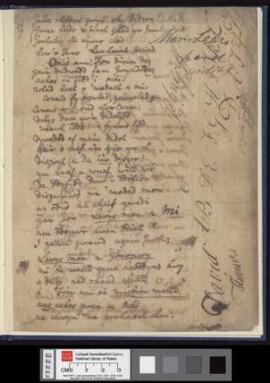
An incomplete transcript by Lewis Morris ('Llewelyn Ddu o Fôn') of 'Cywydd Hiraeth' by Goronwy Owen.
Morris, Lewis, 1701-1765

Morriston War Fund account book,
Subscription account book of the Morriston War Fund, January-December 1916.
Morriston War Fund.

Correspondence, 1915-[1923], of the Comforts Committee of the 11th Service (the so-called Cardiff Pals) Battalion of the Welch Regiment.

The second of two minute books of the Barmouth Belgian Refugees Committee, 19 October 1915-25 April 1916.
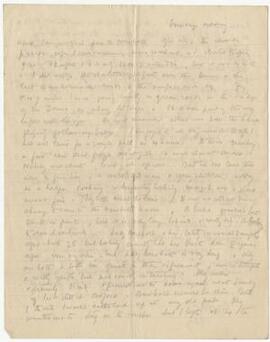
Letter from Edward Thomas to Helen Thomas, addressed Codford, Wiltshire, dated 'Sunday evening'.
Thomas, Edward, 1878-1917

Letter from Edward Thomas to Helen Thomas, sent from France.
Thomas, Edward, 1878-1917
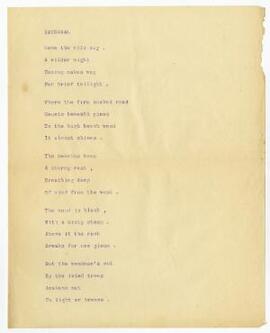
First line: Gone the wild day. Written in Steep. Typescript.
Thomas, Edward, 1878-1917
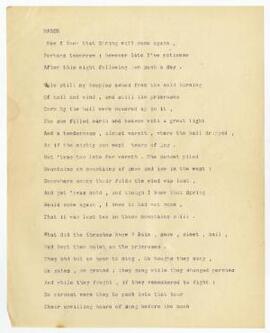
First line: Now I know that Spring will come again. Written in Steep. Typescript.
Thomas, Edward, 1878-1917